

Mina Protocol is preparing for the Mesa Upgrade, a major hard fork designed to transform the network’s performance and expand its capabilities. Inspired by its namesake – a broad, elevated plateau — Mesa represents a significant step in Mina’s evolution. By reducing slot times, expanding on-chain state limits, and introducing automated hard fork mechanisms, Mesa creates a more responsive, powerful platform for the next generation of zkApps.
Back in November, we launched the Mesa testnet and shared an initial timeline outlining the path to Upgrade. In this blog, we’re sharing an update on the current state of play, including results of the recent community vote, and learnings from the Mesa Testnet so far.
On-Chain Vote: All MIPs approved!
In December, the on-chain vote for the Mesa Upgrade concluded with unanimous approval across all four proposed MIPs. With 100% “FOR” votes and 0% “AGAINST,” the community officially greenlit the path toward:
- Reduced block slot time to increase transaction throughput
- Increased on-chain state limits to allow more expressive zkApps.
- Increased events and actions limits to also allow for more complex applications.
- Increased zkApp account update limit to improve zkApp flexibility.
Mesa Testnet: Insights from the pre-flight environment
The o1Labs engineering team, in collaboration with the community, has been putting the Mesa implementation through its paces in the pre-flight environment, and have made significant strides:
- Mesa Package Finalized: The contents of the Mesa release package have been finalized with all protocol-level changes locked in.
- Dry Runs: There have been several upgrade dry runs to test the new features and the results so far have been positive. The runbooks have been updated with data from the dry runs to be used during the mainnet upgrade.
- Automation: The new auto mode, designed to reduce manual coordination requirements and lower operational risk during future upgrades, is also performing as expected. The upgrade of the archive node has also been fully tested in legacy mode.
- Tooling & Compatibility: Rosetta has been successfully tested against the Mesa environment, and o1js now fully supports the new Mesa features.
- zkApp Proof of Concept: We have successfully published and deployed two example zkApps that demonstrate the new protocol changes in action. Read more about these here.
- Exchange Outreach: We have officially commenced outreach to exchanges to begin the coordination required for a smooth hard fork transition.
Additionally, high-load stress tests during initial testing revealed RAM spikes that could lead to “Out of Memory” (OOM) issues for some node operators. To ensure the Mesa Upgrade is a smooth experience for all operators, regardless of hardware, we have made a temporary adjustment to the zkApp transaction limit, which will be set to 12 per block instead of 24.
Because Mesa halves slot time down to 90 seconds, keeping the limit at 12 results in the same total zkApp throughput over time. This means zkApps have the same capacity, but with faster confirmations.
This allows us to ship the Mesa Upgrade and all its benefits immediately. Meanwhile, we are already working on memory optimizations that will allow us to safely raise this limit after the hard fork.
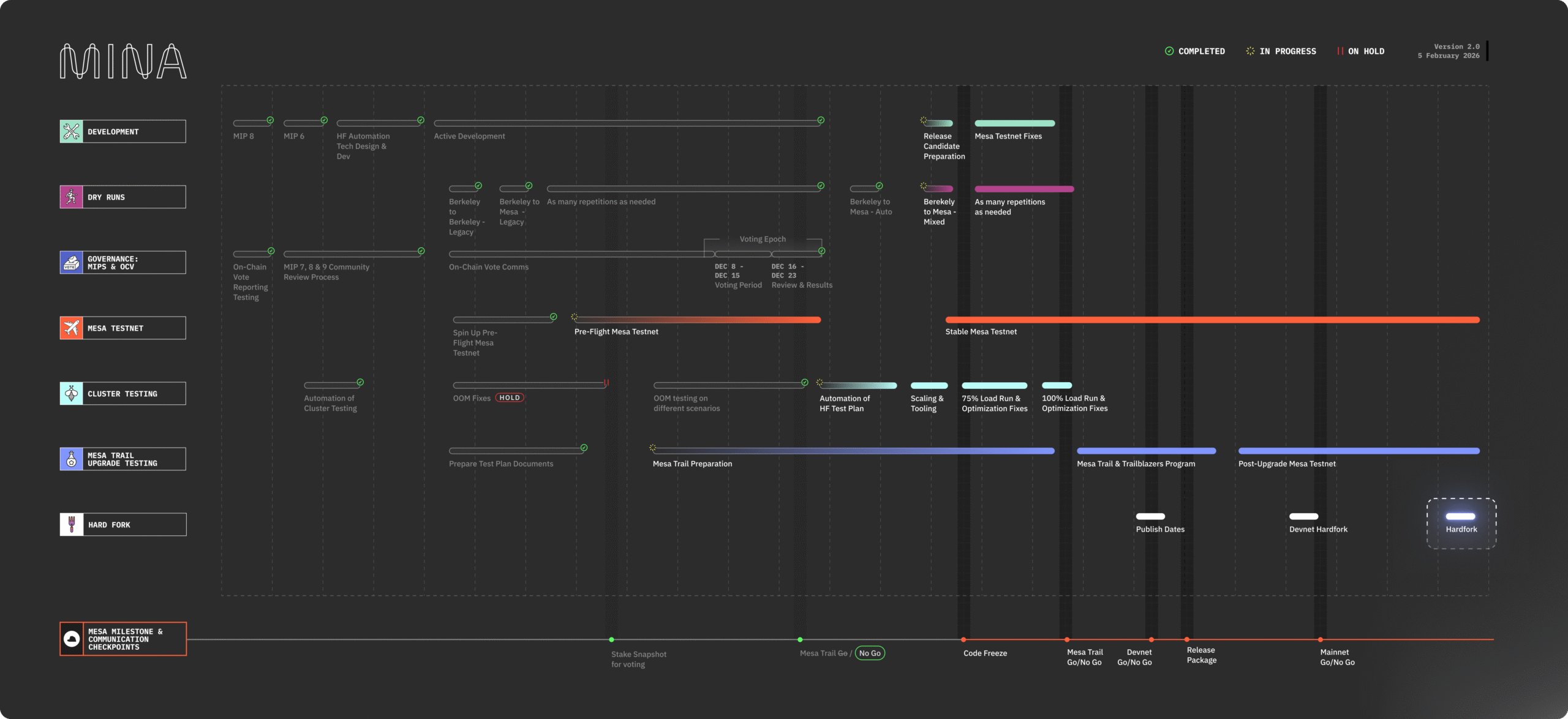
Image link to enlarge.
Next Up: Code Freeze and Mesa Trail
We have officially reached the Code Freeze stage, meaning the Mesa Upgrade codebase is finalized and the release branch is currently being prepared for deployment.
With the bulk of feature validation complete, our focus is now shifting to Mesa Trail, the dedicated upgrade testnet and incentivized program (Trailblazers). This phase is essentially a dress rehearsal for the mainnet hard fork scheduled for later this year, allowing us to practice the upgrade mechanism in a coordinated, real-world environment.
In order to officially launch the Trail, we are focused on:
- Release Branch: Finalizing the dedicated Mesa Trail release branch for deployment.
- Upgrade Monitoring: The tool is in the final stages of development.
- Cluster Testing: Ensuring that the release candidate is stable ahead of the Mesa Trail launch.
Early testing is how we ensure a safe upgrade. We encourage all node operators and developers to continue testing in the pre-flight testnet. If you run critical operations like staking, validation, or payout workflows, please try them on Mesa and share your feedback in Discord.
The Path Ahead
We are committed to keeping the community informed at every major checkpoint. Based on our current progress and the successful resolution of early testing findings, here is the projected timeline for the coming months:
- Mesa Trail: A final readiness review will be conducted to confirm the start of the incentivized phase.
- Trailblazers Program Launch: This is the beginning of the incentivized program, where we will practice the upgrade in a coordinated manner with the community.
- Post-Upgrade Testnet: Post-Trailblazers, we will transition to a stable, long-term testnet environment to validate post-fork network health and performance, as well as resolve any issues identified in testing. Exchanges will also be invited to test ahead of the upgrade.
- Devnet Upgrade: To be scheduled post-Trailblazers, this is the final dry run on a production-like environment before the mainnet upgrade.
A more detailed schedule will be published once Mesa Trail has concluded and the findings are available. Stay up to date on timelines and next steps for the Mesa Upgrade in the Mina Protocol Discord server or on X.
About Mina Protocol
Mina is the world’s lightest blockchain, powered by participants. Rather than apply brute computing force, Mina uses advanced cryptography and recursive zk-SNARKs to design an entire blockchain that is about 22kb, the size of a couple of tweets. It is the first layer-1 to enable efficient implementation and easy programmability of zero knowledge smart contracts (zkApps). With its unique privacy features and ability to connect to any website, Mina is building a private gateway between the real world and crypto—and the secure, democratic future we all deserve.