

Highlights
- Trailblazers successfully concluded after three weeks of testing, bringing together 39 participants from 19 countries to validate Mina’s upcoming Mesa upgrade.
- Participants tested multiple upgrade scenarios, including Berkeley-to-Mesa, emergency hard forks, and Mesa-to-Mesa upgrade paths, alongside archive node, Rosetta, load, and zkApp testing.
- The Mesa Trail network will remain available for continued testing while ecosystem partners, exchanges, and staking pool operators prepare for the upcoming Devnet and Mainnet upgrades.
Overview
Mesa Trail was launched to validate Mina’s Mesa Upgrade in a realistic, production-like environment ahead of the upcoming mainnet upgrade. Over the course of three weeks, 39 experienced ecosystem participants from 19 countries worked alongside the o1Labs engineering team to test upgrade mechanisms, validate operational processes, and identify improvements across multiple components of the network.
The program exercised a wide range of scenarios that operators may encounter, including planned network upgrades, emergency hard forks, archive node migrations, Rosetta compatibility, zkApp testing, load testing, and Mesa-to-Mesa upgrades. Both the legacy upgrade path and the new Automode upgrade process were validated throughout the program.
By testing these scenarios under real-world conditions, participants helped uncover issues that did not surface during internal testing, allowing the engineering team to improve tooling, documentation, and the overall upgrade experience before progressing to the next stage.
A huge thank you to everyone who participated and helped make the program a success.
Fixes & Improvements
As part of Mesa Trail, the Trailblazers program was launched – an incentivized initiative for a select group of experienced node operators chosen to represent different geographies, hardware configurations, and deployment setups. Participants successfully completed multiple upgrade exercises, validating the processes that will be used during the Mesa rollout.
Testing identified several issues affecting the Automode upgrade process, including a configuration mismatch that prevented some nodes from upgrading automatically during the initial Berkeley-to-Mesa upgrade attempt. The issue was quickly identified, resolved, and successfully validated through a second upgrade exercise.
Further testing uncovered improvements related to archive node operation, upgrade tooling, and node performance. Community participants also helped identify high memory usage on some nodes, enabling the engineering team to investigate and deploy fixes while continuing broader performance analysis.
The program also successfully validated Mina’s emergency hard fork procedure, confirming that the network can safely recover even when an upgrade cannot follow the planned stop-slot process. In addition, Mesa-to-Mesa upgrade testing provided valuable insights into future network upgrades, identifying opportunities to further improve the Automode workflow without impacting the upcoming Berkeley-to-Mesa upgrade.
Beyond engineering improvements, participant feedback also led to enhancements across documentation, deployment guides, and operator experience. Feedback highlighted opportunities to simplify upgrade instructions, improve Docker documentation, streamline configuration, and make operational tooling easier to use for node operators. The Trailblazers program also reinforced the value of close collaboration between engineers and the community, with participants praising the responsiveness of the support team and the collaborative atmosphere throughout the program.
Together, these findings have significantly strengthened confidence in the Mesa Upgrade process and will help deliver a smoother experience for ecosystem participants during the upcoming network upgrades.
Next Steps
With Trailblazers now complete, the Mesa Trail network will remain available for continued testing. Ecosystem participants are encouraged to continue validating their infrastructure, applications, and operational processes, with staking pool operators in particular encouraged to test payout workflows in the Mesa environment.
The engineering team will continue incorporating feedback and improvements identified throughout the program while working closely with ecosystem partners, exchanges, infrastructure providers, and node operators as preparations continue for the Devnet upgrade.
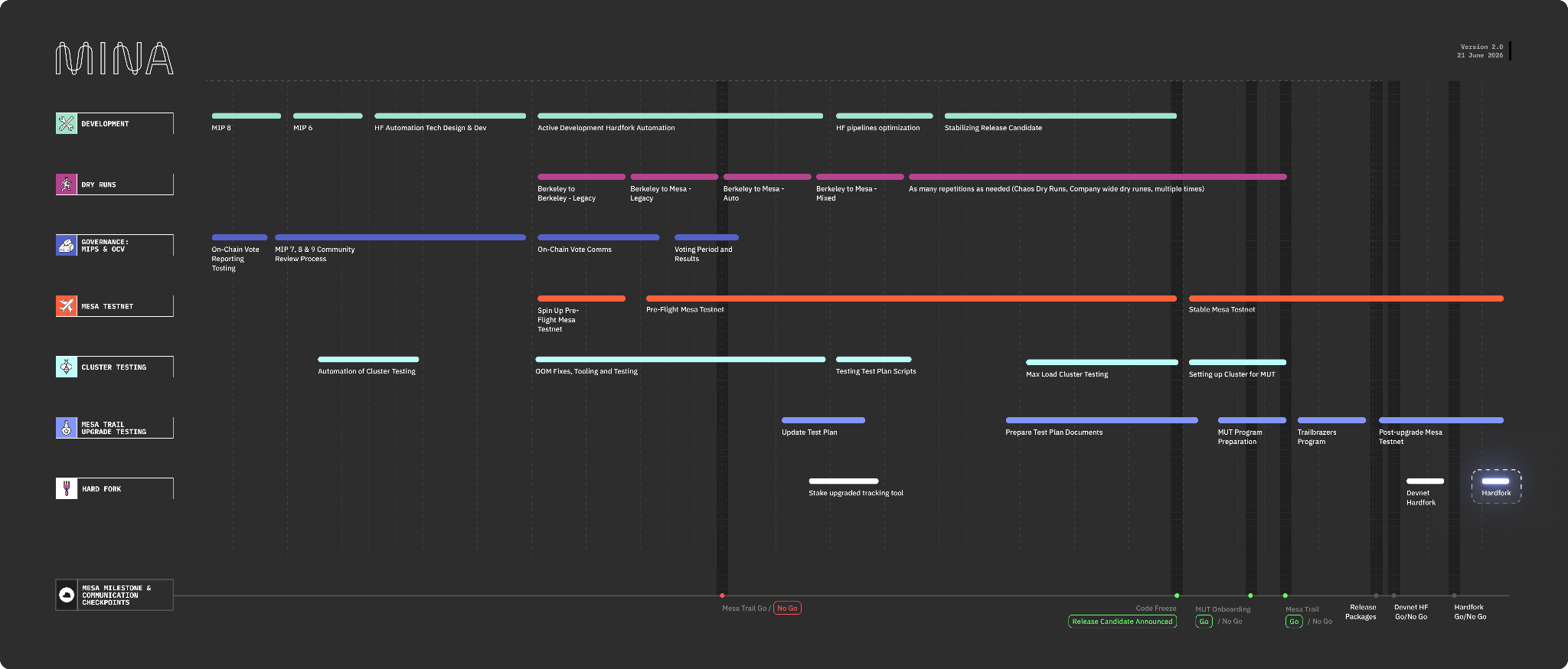
Following successful ecosystem validation on Devnet, the final milestone will be the Mesa Mainnet upgrade. If you’d like to participate in the Devnet upgrade or test Mesa features ahead of the mainnet upgrade, be sure to join the Mina Protocol Discord.
About Mina Protocol
Mina is the world’s lightest blockchain, powered by participants. Rather than apply brute computing force, Mina uses advanced cryptography and recursive zk-SNARKs to design an entire blockchain that is about 22kb, the size of a couple of tweets. It is the first layer-1 to enable efficient implementation and easy programmability of zero knowledge smart contracts (zkApps). With its unique privacy features and ability to connect to any website, Mina is building a private gateway between the real world and crypto—and the secure, democratic future we all deserve.