
Operating blockchain nodes has typically involved complex installation procedures, required costly hardware, and demanded large storage space to manage the continuously growing blockchain state. As a consequence, running nodes is not accessible for the average user.
If we are to achieve true decentralization, we need to make this process much easier and user-friendly.
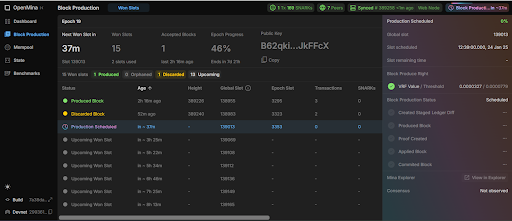
For this purpose, we’ve developed the Mina Web Node, a fully functional blockchain node for the Mina Protocol that operates entirely within your web browser and is capable of producing blocks. It is simple, user-friendly, and easy to install, with an intuitive user interface that you can manage directly from your browser.
Mina’s Web Node
Mina’s Web Node is a block-producing node that operates fully within a web browser. It can also be set as a verification/transaction broadcasting node, and users can simply install their keys and open a new tab in order to run it. There is no need for special hardware, expensive equipment, or advanced technical knowledge. All that is needed is a laptop, a phone, or (eventually) any device with a browser.
Mina is the only blockchain today designed to deliver the promise of an internet that is scalable, secure, and decentralized. Mina’s architecture produces a succinct cryptographic proof that acts as a verifiable representation of the entire blockchain state (~22kb, no matter the size of the blockchain). In contrast, other blockchains have ever-growing data requirements where storage and processing demands exceed what typical consumer hardware can manage within a browser environment. Mina’s compact nature makes the Web Node possible, and the Web Node enables more people to participate in securing the network.
Community Testing Learnings & Results
In February, Mina Foundation opened applications for the Mina community to help with testing the Mina Web Node. Over 300 individuals applied, including developers, node operators, and many people who were new to the Mina ecosystem. 100 people were selected to test the Mina Web Node, based on their prior contributions to the Mina community.
The group received Devnet stake & instructions on how to set up the Web Node and proceeded to test the Web Node between March 4 and March 18, sharing feedback and competing for a variety of prizes based on uptime and block production.
Below is an overview of the program and some key results:
- 388 applicants
- 100 applicants selected and conducted testing
Prizes
Highest Uptime – Top 5 keys with the highest uptime
| Public Key | Prize |
B62qqRQioR2d5rHupAivNUjLb5gdK6XAsko78usmrWjHJMpCvHQ5sot |
1500 MINA |
B62qpaXTiPHdHetEnTrtkogrLaRHbXU3sWUZUjx861TPiuNtzgcmoaF |
1500 MINA |
B62qnxniBn5CRTAuKPtQ4RPDB5bEJSs44pZS7rf1qSc7EEX7DWjmnoe |
1500 MINA |
B62qqc4c37wRgoG1c9ikDuTFkxUu38iGbJ1tYpqvofahqENBmKq6HDF |
1500 MINA |
B62qk5AeiQ3Xz7ViBgcTzCqaz2KcTdcDGB4kdDBK28zxtz5UQVTQAcX |
1500 MINA |
Highest Block Production – Tester who produced the most blocks (canonical and orphaned)
| Public Key | Prize |
B62qrW8cLewBwbeRw74MKPewiRum4PRSifnDLVe3fhHyrcLpWE8bviV |
1500 MINA |
Uptime Prize Draw – Prize draw among those who maintained at least 33.33% uptime (33.33% uptime = 8h/day)
| Public Key | Prize |
B62qrejNj61eZK17CMDGz6p1AparnEejjWniYWdU4TydwVjEgngXPvS |
1500 MINA |
B62qnijReHwBvGqaYKw81rWVFnn2sEtJhqrveBafuVBnCPTkoUcVBs4 |
1500 MINA |
B62qqaWbHjEacMmoYMvmn8DW6YQPEFZLz7WjhDFUopsbxMK7ceTmvbc |
1500 MINA |
B62qo3GQ6VaXoEVDE8yKUJGeVAkyGgwzwoBjnmGSDaLgVcUBcRGSt5E |
1500 MINA |
B62qmBcsQTXMDhw9DiZ6kE7HmJ7HAV3PGckgb2FUD5rTKRyr8SrhYiv |
1500 MINA |
See the prize draw/tie-break process here
Additional Winners – those who displayed Mina’s C.O.R.E. values in their testnet activity, issue reports and contributions
Testnet MVP – 550 MINA + MWN Testnet MVP Role
- Elvis
- Paparai(浪人)
- ziker_official👑 | 🐻👺PH
Outstanding Contributions – 300 MINA
- psteckler
- Bombardier
- jq-rs
- DeYure
- olex_fed
- Leonid83
- t4top
- blackk_magiik
Thanks to the testing and feedback surfaced by participants, we successfully identified areas for improvement, some of which were successfully addressed during the test phase. This includes:
- Seed node performance – Seen only on the first day, this was due to a library that had issues with UDP sockets management. The library was replaced with a better one and the issue was fixed for the scope of this test.
- Memory – The Web Node only had 4GB of memory due to WASM limitations. When the nodes reached the 4GB memory limit, they got stuck or major threads crashed. The fix involves executing the prover in its own memory space separate from the one used by the node, which will ensure the 4GB limit is not hit when proving blocks.
- Network connectivity – This happened when the Web Node itself had poor connectivity (meaning it experienced network instability, low bandwidth, or high latency) or when the peer providing the staged ledgers had similar network issues. A few solutions have been identified to improve this and will be implemented at the end of the testing phase.
There were also a few high-level takeaways based on a post-testing survey which was completed by 73 of the participants:
- Participants appreciated how easy it was to get a Web Node running directly in their browser
- The concept of using the Web Node as a means of decentralization resonated strongly (Participants viewed the elimination of third-party APIs and RPC congestion as an important benefit of the Web Node)
Future Plans for the Web Node
This round of community testing was focused on improving scalability and stability and confirming that the web node works with a variety of devices and from a variety of countries. It was also important to collect feedback from participants to address bugs and make using the Web Node as simple as possible.
o1Labs is now leading Mina’s technical roadmap, and as Brandon shared during the recent Community Call, the Web Node is an important piece of the roadmap, but the rollout of it will be delivered incrementally and come after the proposed Hard Fork which will include important upgrades to the protocol.
About Mina Protocol
Mina is the world’s lightest blockchain, powered by participants. Rather than apply brute computing force, Mina uses advanced cryptography and recursive zk-SNARKs to design an entire blockchain that is about 22kb, the size of a couple of tweets. It is the first layer-1 to enable efficient implementation and easy programmability of zero knowledge smart contracts (zkApps). With its unique privacy features and ability to connect to any website, Mina is building a private gateway between the real world and crypto—and the secure, democratic future we all deserve.